Shoulder Pain: Self-Tests for Rotator Cuff & Swedish Care Pathways
Shoulder pain is the third most common musculoskeletal symptom in outpatient care. When seeking care for shoulder pain in Sweden, distinguishing between subacromial impingement, rotator cuff tendon tears, and adhesive capsulitis (frozen shoulder) is essential for avoiding months of unresolved pain.
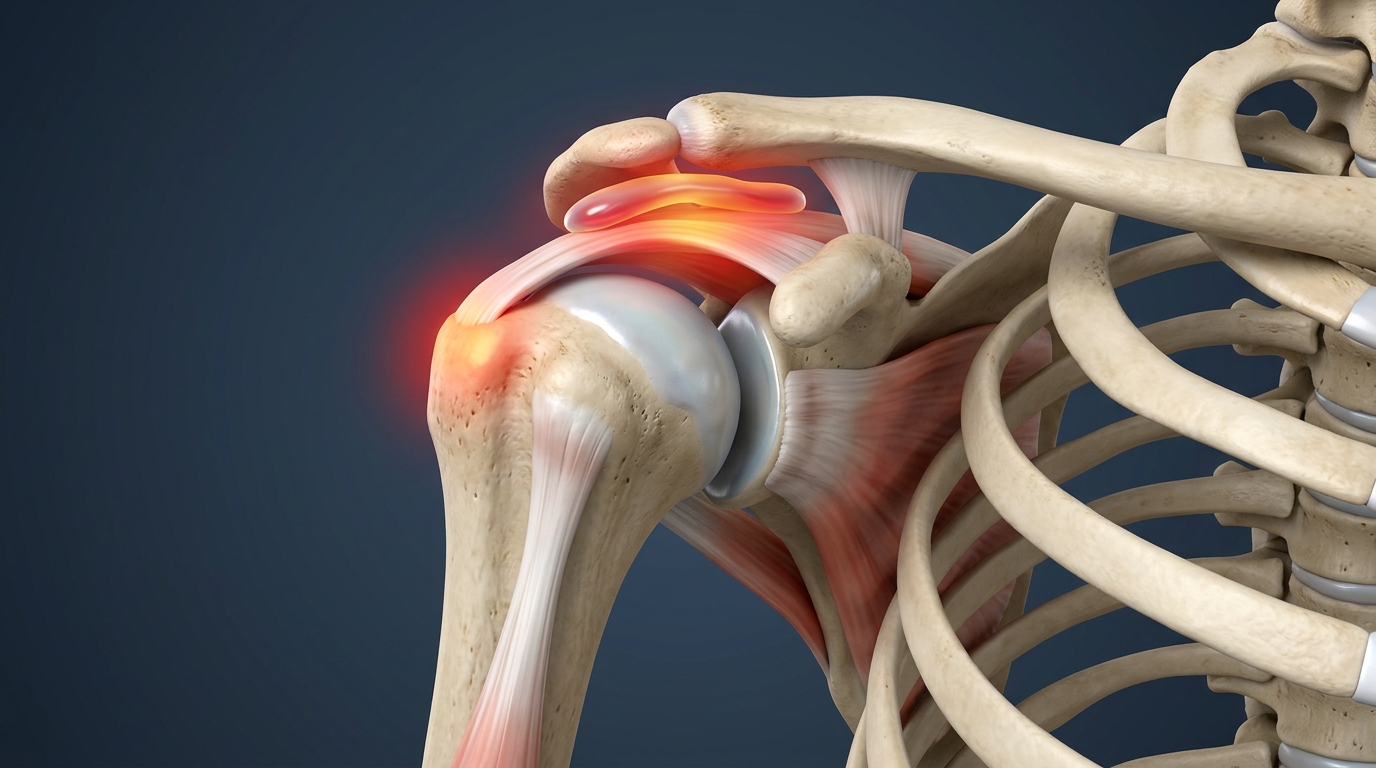
Pain Location and Functional Patterns
Contrary to common perception, rotator cuff pain rarely sits directly on top of the shoulder joint; rather, it typically radiates to the lateral deltoid area of the upper arm.
- Night-time Discomfort: Inability to lie comfortably on the affected shoulder is the classic hallmark of rotator cuff tendinopathy and subacromial bursitis.
- Sudden Weakness vs Pain Inhibition: If the arm unexpectedly drops or cannot sustain light weight overhead, structural tendon disruption is strongly suspected.
- Global Restriction of Passive Movement: If external rotation is severely restricted (<30 degrees) even when assisted by another person, frozen shoulder (adhesive capsulitis) is the most probable cause.
Three Guided Orthopedic Self-Tests
Perform these movements slowly in front of a mirror. Stop if you experience sharp or stabbing pain.
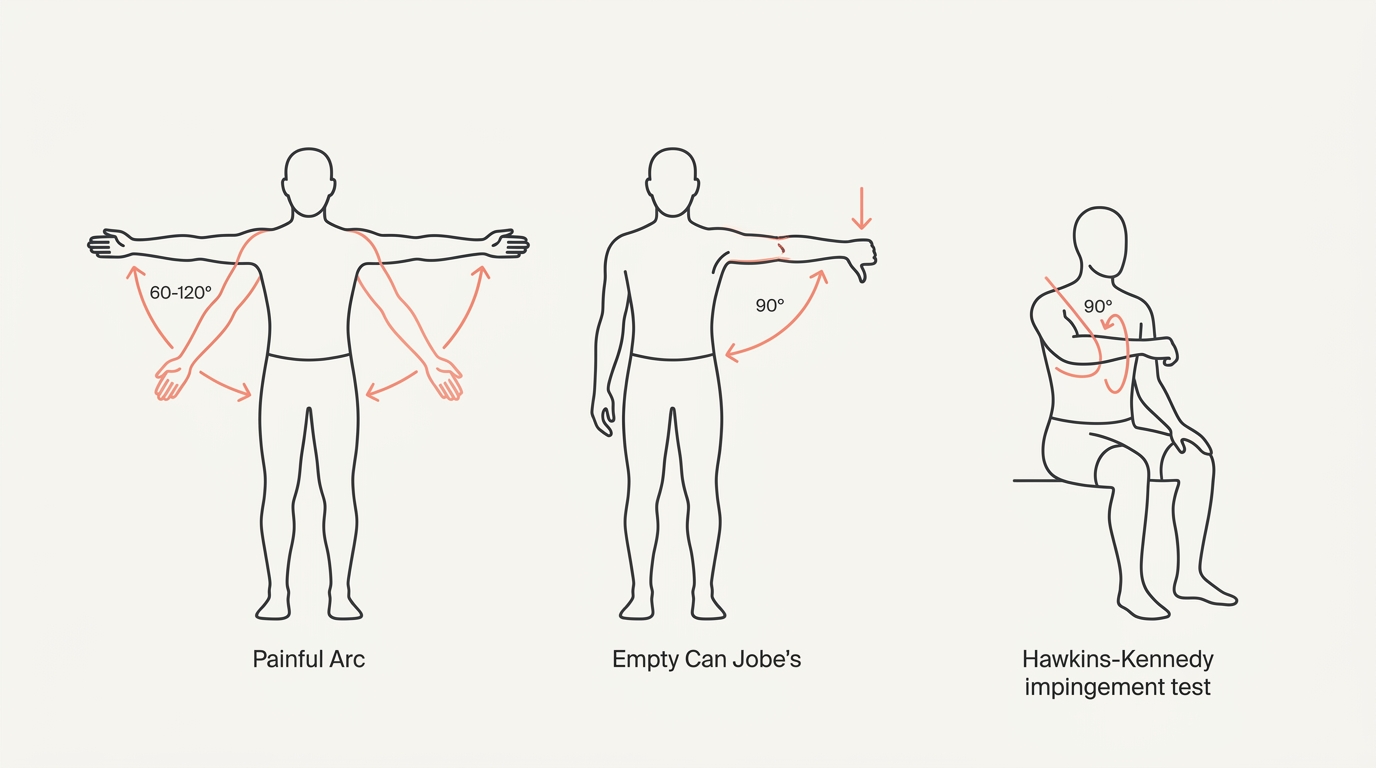
Test 1: Painful Arc Test (Subacromial Impingement)
Procedure: Stand straight and lift both arms slowly out to the sides and overhead in a wide arc (frontal plane abduction). Note where along the movement arc discomfort occurs.
Positive Finding: Free movement between 0° and 60°, followed by prominent pain between 60° and 120° that diminishes once the arm reaches full overhead elevation (120°–180°), strongly indicates subacromial impingement.
Test 2: Empty Can / Jobe's Test (Supraspinatus Tendon)
Procedure: Elevate your painful arm 90 degrees forward-sideways (in the scapular plane, ~30° anterior to full side). Rotate your thumb pointing straight down towards the floor (as if emptying a soda can). Try to maintain this position against light downward pressure applied by your other hand.
Positive Finding: Sharp pain or inability to resist pressure (arm drops) points towards supraspinatus tendinopathy or a partial/full-thickness tear.
Test 3: Hawkins-Kennedy Impingement Test
Procedure: Raise the painful arm 90 degrees forward with the elbow bent at 90 degrees across your chest. Use your opposite hand to gently push the forearm downwards into internal rotation.
Positive Finding: Sharp pain inside the anterior or lateral shoulder joint as the greater tuberosity is compressed beneath the coracoacromial arch confirms positive impingement sign.
Differential Diagnosis Matrix
| Condition | Range of Motion | Hallmark Symptoms | Recommended Diagnostic Pathway |
|---|---|---|---|
| Subacromial Impingement | Full passive ROM; active painful arc (60°–120°). | Pain during overhead activities, lateral upper arm ache at night. | Clinical physiotherapist exam + Ultrasound / MRI if unresolved. |
| Rotator Cuff Tear (Partial/Full) | Marked weakness during abduction & external rotation. | Sudden loss of lifting strength; often follows acute fall or prolonged wear. | Shoulder MRI is required to assess tear size, retraction, and fatty infiltration. |
| Frozen Shoulder (Capsulitis) | Severely restricted active AND passive ROM (especially external rotation). | Constant deep aching in early freezing stage, followed by severe stiffness. | Clinical exclusion diagnosis + MRI to rule out articular destruction. |
| AC Joint Osteoarthritis | Pain at end-range cross-body adduction. | Focal tenderness right on top of the shoulder collarbone bump. | Plain radiograph or targeted MRI. |
⚠️ Red Flags – When to Seek Emergency Care
If shoulder discomfort occurs in combination with chest pressure, shortness of breath, nausea, or jaw ache, call emergency services immediately (potential myocardial infarction). Acute inability to raise the arm following a traumatic sports injury or fall may indicate shoulder dislocation or traumatic rotator cuff rupture requiring prompt surgical evaluation.
When Should You Consider a Private Shoulder MRI in Sweden?
Navigating the Swedish public queue for non-emergency orthopedic MRI scans frequently takes 3 to 6 months. When conservative rehabilitation plateaus, a private Shoulder MRI provides decisive answers within days:
- Differentiates between tendinopathy suitable for exercise therapy vs. acute full tears requiring surgical repair.
- Evaluates the degree of fatty muscle atrophy (Goutallier stage), which determines surgical success.
- Identifies labral tears (SLAP lesions) and biceps tendon pathology.
Access Specialist Consultation & Rapid MRI in Sweden
Schedule a tele-physiotherapy evaluation within 24 hours (SEK 690), or secure our complete orthopedic investigation bundle with guaranteed private MRI within 10 days (SEK 9,900).
Book at Vård.se →